News
AutoWallis closes the first half profitably despite challenging automotive market conditions
News
AutoWallis closes the first half profitably despite challenging automotive market conditions
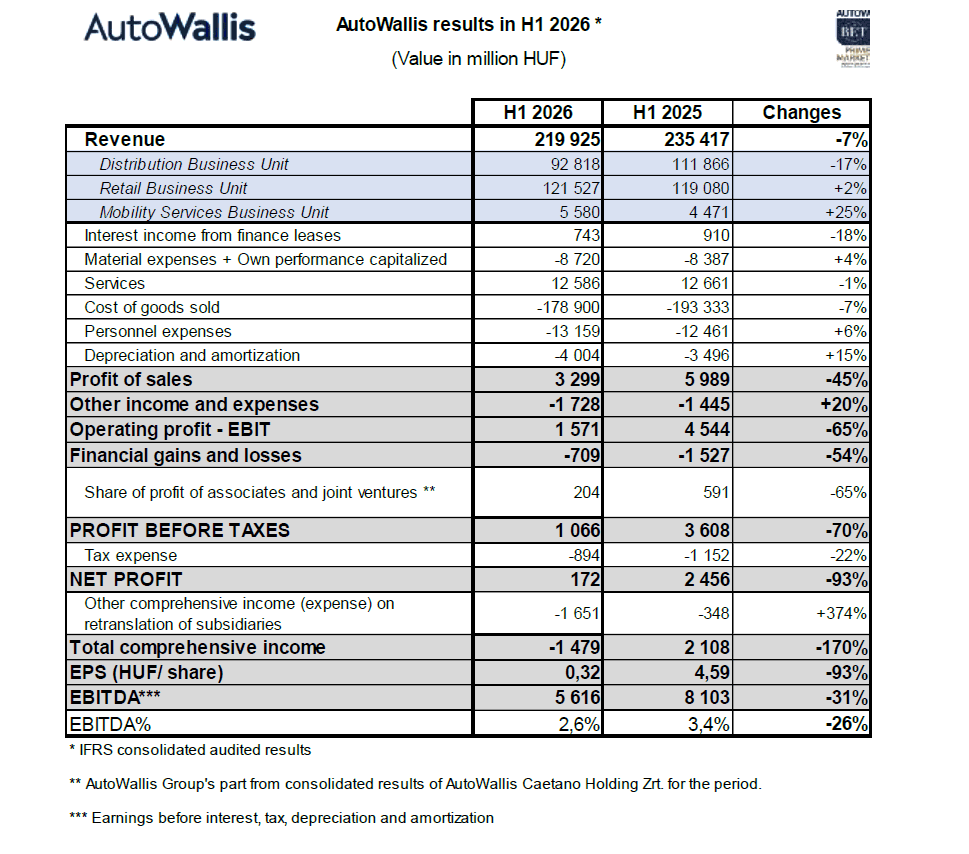
AutoWallis’s first-half performance was shaped by challenging automotive market conditions, the subdued performance of traditional brands, one-off costs related to the market launch of Chinese brands, and efficiency improvement measures. As a result of these and other factors, the company’s revenue decreased by 7%, while its EBITDA declined by 31%. AutoWallis expects the new Chinese brands added to its portfolio to offset the decline of other brands over the medium term; in the short term, however, they weigh on results, while other developments and the diversified portfolio continue to point toward stable growth.
The 2% growth of the Retail Business Unit was not enough to offset the 17% decline in the Distribution Business Unit, resulting in a 7% overall decrease in the first-half revenue of AutoWallis Group to HUF 219.9 billion compared to the same period last year. Several factors were behind the unfavorable developments: the rapid entry of a large number of Chinese brands into European markets, including the Central and Eastern European region that is particularly important for AutoWallis, is, on the one hand, putting pressure on traditional (incumbent) brands and creating significant price competition across the market. On the other hand, the market launch of these new brands entails significant start-up costs in the short term for their distributors, including AutoWallis. AutoWallis expects the new brands added to its portfolio to offset the decline of incumbent brands over the strategic horizon; in the short term, however, they weigh on results, while other developments and the diversified portfolio continue to point toward stable growth and consolidation.
Of the three business units of AutoWallis Group, the Mobility Services Business Unit delivered the strongest growth in the first six months of the year: its revenue increased by 25% to HUF 5.6 billion, primarily due to the stronger performance of car-sharing and rent-a-car services. The average fleet size of AutoWallis Group was 5.4% higher than in the same period of the previous year, driven by the growing customer base of its fleet management services. The Retail Business Unit also closed the first half with growth: its revenue increased by 2% to HUF 121.5 billion, alongside a 9.7% increase in new vehicle sales and a 5.6% decrease in used vehicle sales (the latter due to a strong base effect). Revenue growth in the business unit was partly attributable to the opening of the Debrecen dealership in the fourth quarter of 2025 and partly to organically increasing sales volumes. The fact that revenue growth was lower than the increase in unit sales is explained by product mix effects, the higher share of intra-group sales compared to the previous period, and the strengthening of the Hungarian forint. Among AutoWallis’s markets, Slovenian retail operations stood out with 27% growth, while sales volumes increased by 4% in the Czech Republic and 2% in Hungary. Revenue in the Distribution Business Unit declined by 17% to HUF 92.8 billion in the first half of the year, with several unfavorable factors contributing to the decrease: the business unit sold 3.5% fewer vehicles during the period, the strengthening of the Hungarian forint had a significant impact, while changes in model mix and prices also had a smaller adverse effect. The contraction was primarily due to lower sales of the KGM (-1,577 units) and Opel (-203 units) brands, which were only partially offset by growth in the other brands. The former was attributable to increasing competition in the segment and the sell-down of dealer inventories accumulated in the previous period, while the latter was attributable to temporary production capacity constraints. At the same time, the order book indicates robust demand, and deliveries delayed due to production capacity constraints are therefore expected to be completed in the second half of the year.
The efficiency improvement measures introduced last year could not yet offset the challenging environment, the subdued performance of traditional brands, the price competition resulting from the advance of Chinese brands, and the one-off costs associated with their market launch. As a result, EBITDA decreased by 31% overall to HUF 5.6 billion, while the EBITDA margin declined to 2.6% (-26%). The company’s results were favorably affected by the HUF 204 million share of profit attributable to AutoWallis from companies jointly managed with strategic partners, in which it holds a 50% ownership stake, although, for reasons similar to those described above, this was also below the HUF 591 million recorded in the same period last year. The company’s net profit amounted to HUF 172 million, while earnings per share were HUF 0.32. AutoWallis’s gross margin generating capacity increased by 4% compared to the previous period to 18.7%, demonstrating the underlying strength of its operations and the resilience of its portfolio. The ramp-up of new brands and ongoing business developments may contribute to the Group’s profit-generating capacity over the medium and long term.
The administration of finances at AutoWallis, listed on the Prime Market of the Budapest Stock Exchange, shows that the cost of goods sold (COGS) declined by 7% to HUF 178.9 billion, in line with the decrease in revenue. Personnel expenses increased by 6% to HUF 13.2 billion, primarily due to the opening of the Debrecen dealership in the fourth quarter of 2025 and wage increases implemented in response to labor market expectations (the Group’s average headcount at fully consolidated companies increased by 5.4% to 1,559 employees in the first half compared to the same period of 2025). The negative balance of financial income and expenses amounted to HUF -709 million in the first half of 2026, representing a 54% improvement compared to the same period of the previous year. The balance of interest expenses and interest income remained at the same level as in the comparative period; the increase in financial expenses related to leases is attributable to the larger fleet size in the Mobility Services Business Unit, as well as newly leased properties. Realized and unrealized exchange rate differences resulting from changes in the Hungarian forint exchange rate developed favorably compared to the comparative period, with the HUF 1.7 billion profit attributable to the forint exchange rate at the reporting date.
Commenting on the first-half results, Gábor Ormosy, CEO of the AutoWallis Group, said that the strategic focus of AutoWallis continues to be on expanding its importer portfolio, strengthening its retail presence, and developing its mobility business, which support the sustainable long-term strengthening of its profit-generating capacity and growth. Another significant portion of the Group-level measures aimed at improving operating efficiency was completed in the first half; however, their effects will only materialize in the coming quarters. The developments implemented by the company, the opening of new dealerships, and the addition of new brands to the portfolio may increasingly contribute first to revenue growth and then to profit growth in the coming periods. The strategic directions set previously and the conditions for regional consolidation remain in place, while the results achieved to date provide a stable foundation for continuing the consolidation strategy, with management continuously adapting its implementation to market realities.